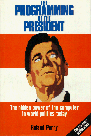
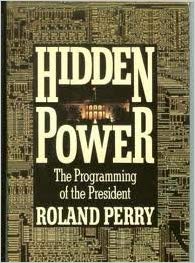
Roland Perry, The Programming of the President: the Hidden Power of the Computer in World Politics Today, London: Aurum Press, 1984.
It's necessary to keep in mind that this book deals in neither theory nor fantasy, but fact. National and state elections are being controlled by computer systems which direct the campaigns of the candidates. Television programs, magazine and journal articles are created in direct relation to computer simulation systems which indicate specifically how the American mind can be controlled. All details of U.S. citizens' personalities are being captured in computer systems. These systems are then used to program political candidates and political campaigns so that the candidates and office holders speak and act in ways which control citizens to vote for them and to keep them in power.
The computer "can be used to program entirely a candidate's bid for political office. This is no longer some science fiction dream or a possibility for the twenty-first century. It has already happened."
Data about American voters is gathered from census statistics, voting records, demographics (age, ethnic group, gender, address, etc.), and from highly complex polling questionnaires which selected people answer.
"For example, if a random sample of 600 people in California were asked whether they proposed to vote for Reagan or Unruh in the [California gubernatorial] election [of 1970], the response would be accurate to within 3 per cent, 95 times out of every 100 samples taken. In other words, if operators telephoned 600 people at random in California, and went through the same procedure another 99 times, each time with 600 different people, on average 5 samples could be thrown away, because they would be the bad apples. The other 95 would be accurate to within plus or minus 3 per cent. If the sample said that 56 per cent of people would vote for Reagan, then there was a high degree of probability that the Governor [Reagan] would receive between 53 and 59 per cent of the vote in the state."
 All elements of the voters' personal beliefs, attitudes, and feelings are captured in these computer systems.
The computer knows, from questionnaires and other data, precisely what each population segment feels about all major issues: the military, foreign and domestic policy, welfare, social security, crime, drugs, education, etc. If the computer simulation system indicates that the American people are interested in what the president plans to do about education, then Trump will give a speech about education, promising precisely what the computer data indicates he should promise.
All elements of the voters' personal beliefs, attitudes, and feelings are captured in these computer systems.
The computer knows, from questionnaires and other data, precisely what each population segment feels about all major issues: the military, foreign and domestic policy, welfare, social security, crime, drugs, education, etc. If the computer simulation system indicates that the American people are interested in what the president plans to do about education, then Trump will give a speech about education, promising precisely what the computer data indicates he should promise.Roland Perry's book details how the computer simulation systems of Richard Wirthlin and Pat Caddell operated to get Jimmy Carter and Ronald Reagan elected to the presidency.
"...It was not simply the fact that he [Reagan] had a long career of acting behind him which allowed him to deliver the right line, mood or expression when required. He had also been a governor for eight years, a candidate four times (five if his 1968 bid for the Presidency was counted) in state and national elections over fifteen years. Regan's six years as a front man with General Electric, in which he had visited 150 plants in 38 states, had made him responsive to and experienced with live audiences so that he was equally at home in front of a camera or a crowd. A combination of acquired skills as a film and TV actor, politician, PR man, candidate, journalist and radio announcer over forty years had made him the most nearly perfect person for programming in the history of politics."
The same simulation techniques are used today in securing the election of a presidential nominee and in the influencing of the American mind to accept domestic and foreign policies which American leaders use to realize their personal goals.